


Long multiplication – grade 4 worksheet with answers
A free worksheet on long multiplication with a detailed answer key is further down. Übungsfrisch keeps creating new multiplication tasks on this topic, and your child never gets the same one twice.
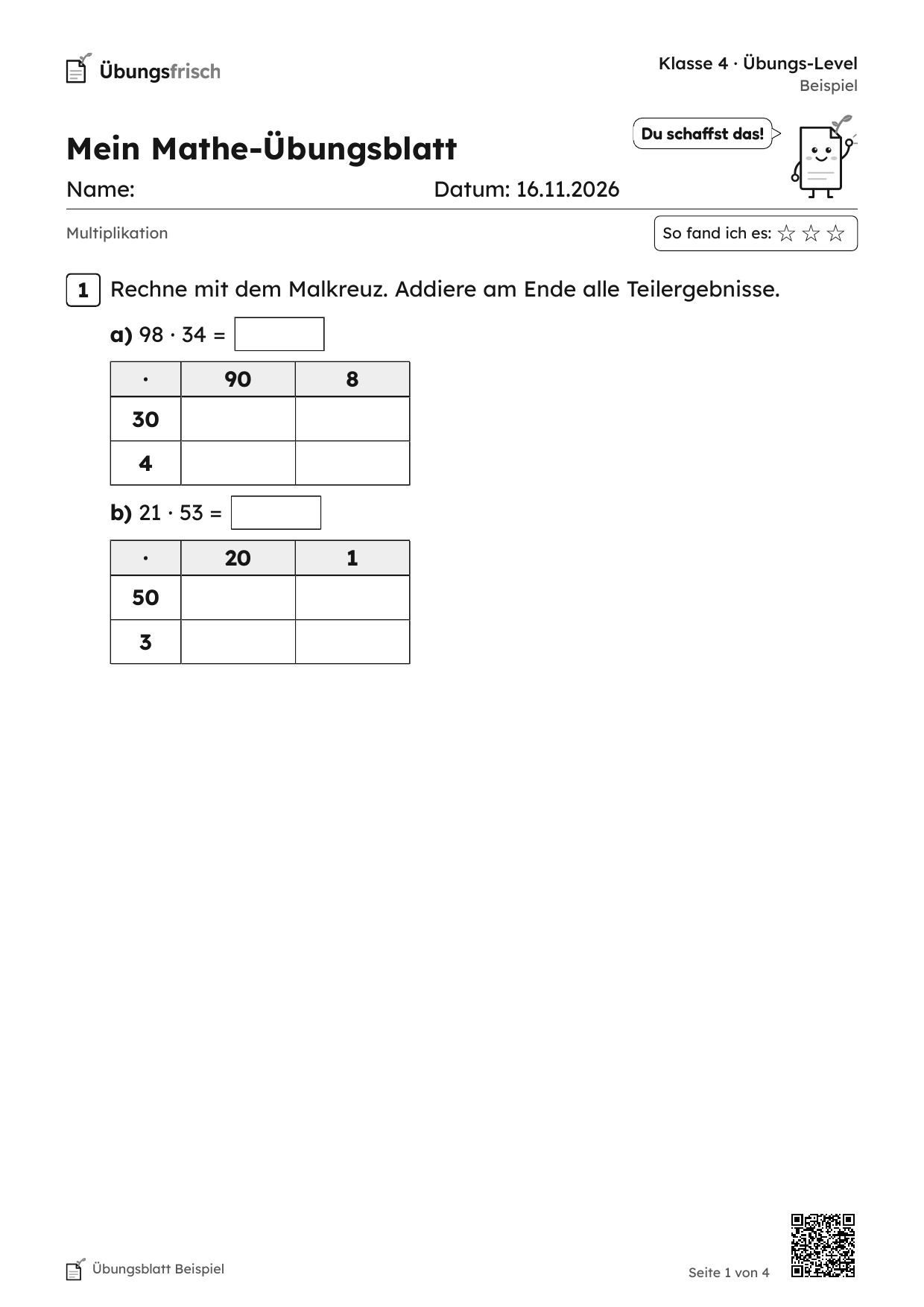
Free sample worksheet
A real worksheet with 7 exercises, just as Übungsfrisch creates it, plus the matching answer key with worked solutions. Like the maths lessons at your child’s school, the sheet is in German. Print it on A4 – no sign-up needed.
What it’s about
In grade 4 your child learns written multiplication (schriftliches Multiplizieren) of larger numbers, usually a three-digit number times a two-digit one. Often the grid method (Malkreuz) comes first: 47 · 36 is split into 40 · 30, 7 · 30, 40 · 6 and 7 · 6, and the four partial results 1.200, 210, 240 and 42 add up to 1.692. This shows why the written method works. German schools write · for times and a point between the thousands, so 1.692 is one thousand six hundred and ninety-two.
In the written method the first number is multiplied by each digit of the second in turn. On the sample sheet your child starts with the tens digit: for 254 · 32 they first work out 254 · 3 = 762, then 254 · 2 = 508. The second row ends one place further right, because the 3 stands for 30. Finally both rows are added: 7.620 + 508 = 8.128. Some classes start with the ones digit – the result is the same, only the rows are the other way round. If the layout looks different from what you learnt, let your child show you their class’s way.
Your child also calculates with the grid method, multiplies in writing with an estimate and checks other children’s results. These contain typical mistakes: a row that wasn’t shifted, or one zero too many. An estimate such as 700 · 50 = 35.000 exposes this at once.
Typical mistakes
- The second row isn’t shifted: for 213 · 24, 426 and 852 are added straight under each other – the result is 1.278 instead of 5.112.
- A carry gets lost: in 248 · 3, 8 · 3 = 24, and the 2 belongs to the next step. Forgetting it gives 724 instead of 744.
- One zero too many goes unnoticed: 580 · 41 = 237.800 can’t be right, because the estimate 600 · 40 gives only 24.000. The correct answer is 23.780.
Example tasks
Use the grid method: 36 · 54
Show answer
1.944 (30 · 50 = 1.500, 6 · 50 = 300, 30 · 4 = 120, 6 · 4 = 24)
Multiply in writing: 327 · 46
Show answer
15.042 (327 · 4 = 1.308 and 327 · 6 = 1.962, then 13.080 + 1.962 = 15.042)
A child worked out 612 · 29 = 6.732. Can that be right?
Show answer
No, the estimate 600 · 30 = 18.000 doesn’t fit. The correct answer is 17.748 – the row 1.224 wasn’t shifted (12.240 + 5.508).
Practising at home
Make up everyday tasks together, such as 23 rows of 18 chairs each, and let your child estimate first, then calculate exactly. When checking the sheet, the in-between rows on the answer key show where a mistake crept in.
A new sheet on exactly this topic every time – no repeats
With Übungsfrisch you pick the topic your child is doing at school right now and get a new worksheet every time, with an answer key and worked solutions. Join the waitlist – we’re inviting families step by step.
Join the waitlistRelated topics
- Long division – grade 4 worksheet with checksLong division (schriftlich dividieren) by one-digit numbers: zeros in the answer, checking, estimating, finding errors. Free grade 4 worksheet, answers.
- Rounding and estimating – grade 4 worksheetRounding in grade 4 in Germany: to thousands, ten thousands and hundred thousands, neighbouring numbers and estimating. Free worksheet with answer key.
- Numbers to a million – grade 4 worksheet with answersNumbers to a million for grade 4 in Germany: place value chart up to HT, number words, splitting numbers and number lines. Free worksheet with answer key.