


Comparing and ordering decimals – grade 6 worksheet
Below there’s a free worksheet on comparing and ordering decimals, with answer key. With Übungsfrisch your child keeps getting new pairs of numbers on exactly this topic, without repeats.
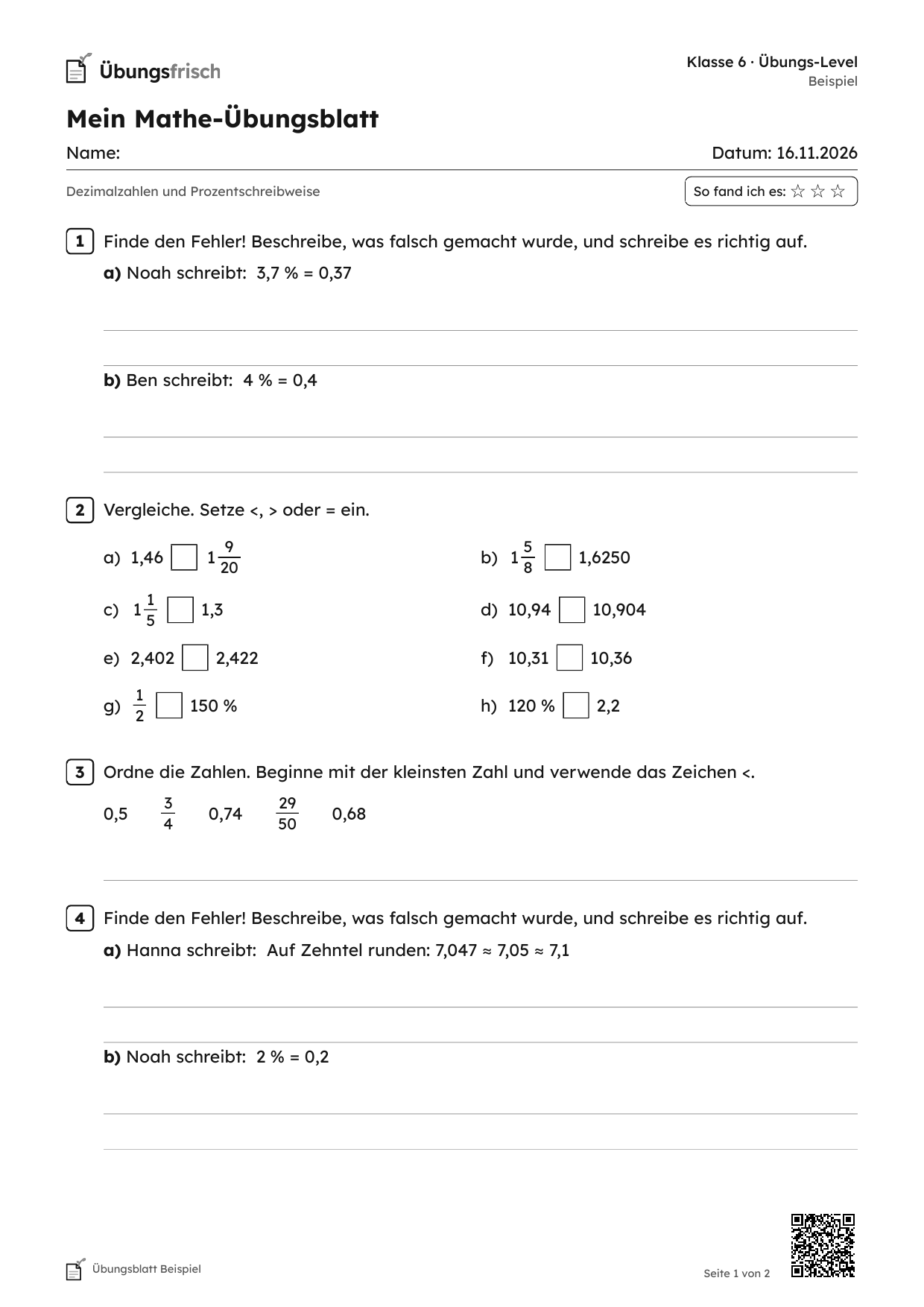
Free sample worksheet
A real worksheet with 8 exercises, just as Übungsfrisch creates it, plus the matching answer key with worked solutions. Like the maths lessons at your child’s school, the sheet is in German. Print it on A4 – no sign-up needed.
What it’s about
Which number is bigger, 0,5 or 0,45? German schools write a decimal comma (0,5) and separate decimals in a list with semicolons. Many children say 0,45, because 45 is bigger than 5. That’s exactly where this topic starts: decimals aren’t compared by their length but place by place from the left – first the ones, then the tenths, then the hundredths. 0,5 has 5 tenths, 0,45 only 4, so 0,5 is bigger.
A useful trick from class: add trailing zeros until both numbers have the same number of decimal places. 0,50 and 0,45 can then be compared like 50 and 45. Trailing zeros don’t change the value: 0,040 and 0,0400 are equal. It gets harder with mixed forms: to compare 3/8 with 0,38, you convert first, 3/8 = 0,375. With recurring decimals such as 1/3 = 0,3̅ (the bar marks the repeating digit) it’s worth writing out a few more places.
On the sample sheet your child fills in <, > or =, orders numbers in different forms and explains mistakes others have made. By the end they should order any list of decimals confidently and explain why a longer number isn’t automatically bigger.
Typical mistakes
- The longer number is taken to be bigger: 0,45 is smaller than 0,5, because 4 tenths are less than 5 tenths.
- Trailing zeros are thought to change the value: 2,70 is exactly as big as 2,7.
- Recurring decimals are cut off: 1/3 = 0,3̅ is a little bigger than 0,33, not equal to it.
Example tasks
Fill in <, > or =: 1,307 □ 1,37
Show answer
1,307 < 1,37 (same tenths, but 0 hundredths against 7 hundredths)
Fill in <, > or =: 5/8 □ 0,6
Show answer
5/8 > 0,6, because 5/8 = 0,625
Put in order, starting with the smallest: 0,45; 0,405; 0,54; 0,5; 0,045
Show answer
0,045 < 0,405 < 0,45 < 0,5 < 0,54
Practising at home
Sports times work well: let your child order 9,8 s, 9,75 s and 9,08 s and say aloud which place they are comparing – a few minutes is enough. For mistakes on the sheet, the answer key shows the conversion that settles the comparison.
A new sheet on exactly this topic every time – no repeats
With Übungsfrisch you pick the topic your child is doing at school right now and get a new worksheet every time, with an answer key and worked solutions. Join the waitlist – we’re inviting families step by step.
Join the waitlistRelated topics
- Rounding decimals – grade 6 worksheet with answersRound decimals to tenths, hundredths and thousandths, with the rounding rule and number line: free grade 6 worksheet for school in Germany, with answers.
- Fractions, decimals and percentages – conversion table and grade 6 worksheetConvert fractions, decimals and percentages in grade 6: complete the table, match equal values, work out percentage shares. Free worksheet with answers.
- Fractions to decimals – grade 6 worksheet with answersConvert fractions to decimals, terminating and recurring, including long division: free worksheet for grade 6 at Gymnasium in Germany, with answers.