


Number bonds with the number house – grade 1 worksheet
Further down you’ll find a free number house worksheet with answers to print. With Übungsfrisch your child gets new houses and numbers for splitting numbers every time, and nothing repeats.
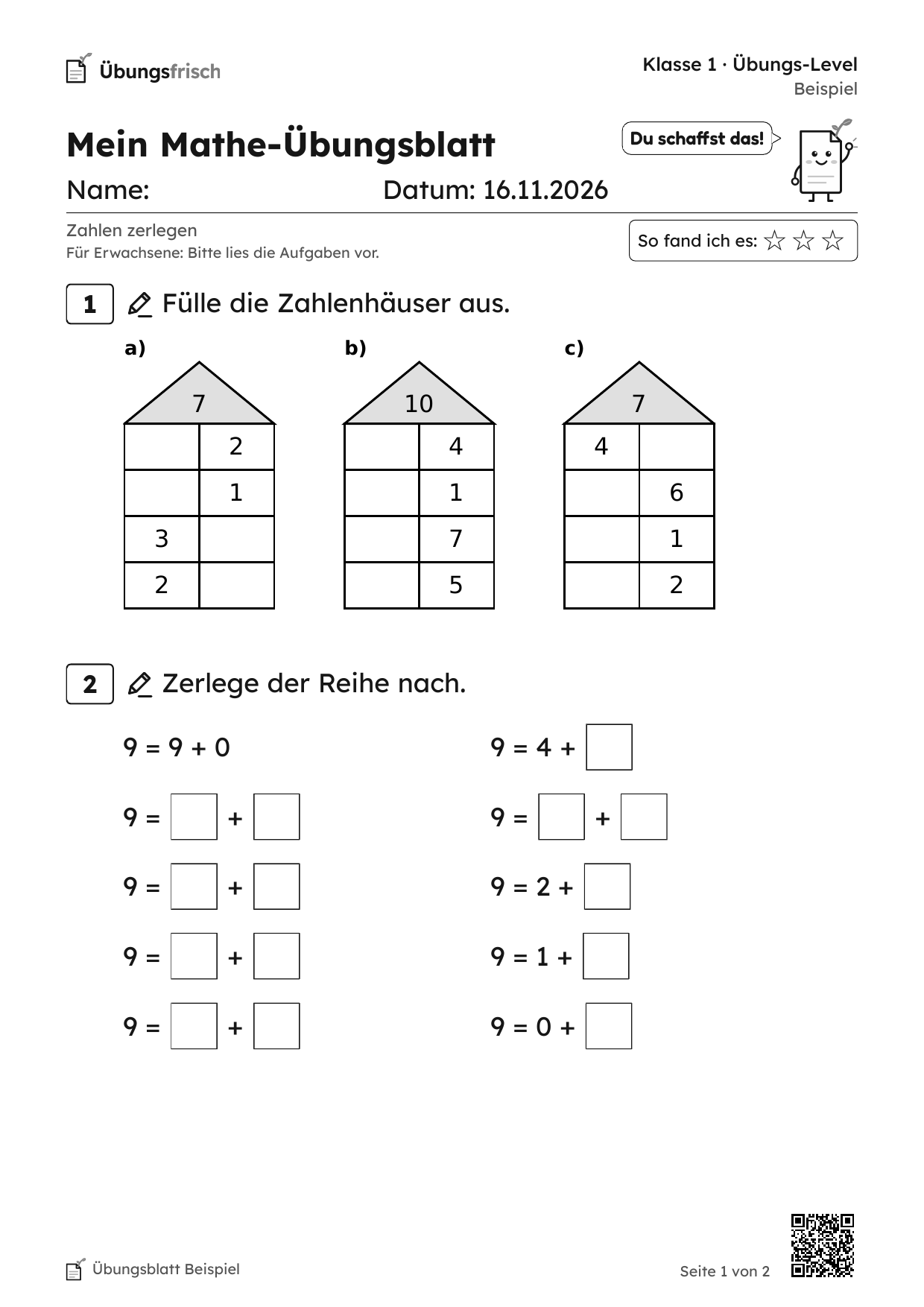
Free sample worksheet
A real worksheet with 5 exercises, just as Übungsfrisch creates it, plus the matching answer key with worked solutions. Like the maths lessons at your child’s school, the sheet is in German. Print it on A4 – no sign-up needed.
What it’s about
Splitting numbers (Zahlen zerlegen, number bonds) means breaking a number into two parts. 7 is 3 and 4, but also 5 and 2, or 7 and 0. Children who know these splits up to 10 by heart calculate much faster later, because almost every addition and subtraction builds on them. The pairs that make 10 matter most; children often call them „verliebte Zahlen“ (“numbers in love”), for example 7 and 3 or 6 and 4.
At school this is often practised with the number house (Zahlenhaus): the number sits in the roof, and on every floor the two numbers add up to the roof number. On the sample sheet your child fills in number houses, writes the matching split for pictures of counters, solves tasks that make 10 and splits a number in order: 9 = 9 + 0, 9 = 8 + 1 and so on. Along the way they discover a pattern – the first number always gets 1 smaller, the second 1 bigger. You read the tasks aloud, because many children can’t yet read with confidence; the sheet prints a note for adults and a small picture symbol in front of each exercise.
By the end your child should find all the splits of every number up to 10 and name the partner to 10 without counting. That’s exactly what they’ll need later for bridging ten (Zehnerübergang).
Typical mistakes
- Adding instead of completing in the number house: in the house with roof number 7, the number next to 3 is 4, not 10.
- The 0 is forgotten: 8 = 8 + 0 and 8 = 0 + 8 are splits too, and they’re often missing from the list.
- The starting number is counted when making 10: from 6 to 10 is 4, not 5 – a child who counts “6, 7, 8, 9, 10” on their fingers ends up with 5.
Example tasks
Fill in the number house with roof number 8: 5 + __, 2 + __, __ + 8
Show answer
3, 6 and 0 (5 + 3, 2 + 6 and 0 + 8 each make 8)
Which number is missing? 10 − __ = 7
Show answer
3, because 7 and 3 make 10 together
Split 5 in order. Start with 5 = 5 + 0.
Show answer
5 + 0, 4 + 1, 3 + 2, 2 + 3, 1 + 4, 0 + 5 – that’s 6 splits
Practising at home
Make a shaker box: put 6 buttons in a tin with a cardboard divider, close the lid and shake – your child says how the buttons have landed, for example “2 and 4”. On the answer key the number houses are filled in completely, so you can see every floor at a glance.
A new sheet on exactly this topic every time – no repeats
With Übungsfrisch you pick the topic your child is doing at school right now and get a new worksheet every time, with an answer key and worked solutions. Join the waitlist – we’re inviting families step by step.
Join the waitlistRelated topics
- Adding and subtracting to 10 – grade 1 worksheet with answersGrade 1 maths in Germany: addition and subtraction to 10 with picture tasks, inverse tasks and missing numbers. Free printable worksheet with answers.
- Numbers to 20 – grade 1 worksheet with the twenty frameGrade 1 maths in Germany: count to 20 with dice pictures, the twenty frame (Zwanzigerfeld) and tally marks. Free printable worksheet with answer key.
- Bridging ten and calculating to 20 – grade 1 worksheetBridging ten (Zehnerübergang) in grade 1: first to 10 and then on, doubles and near doubles to 20. Free worksheet for school in Germany, with answers.