


Bridging ten and calculating to 20 – grade 1 worksheet
Here you can download a free worksheet on bridging ten, with answer key. Übungsfrisch creates new exercises on this topic every time, and none of them turns up again later.
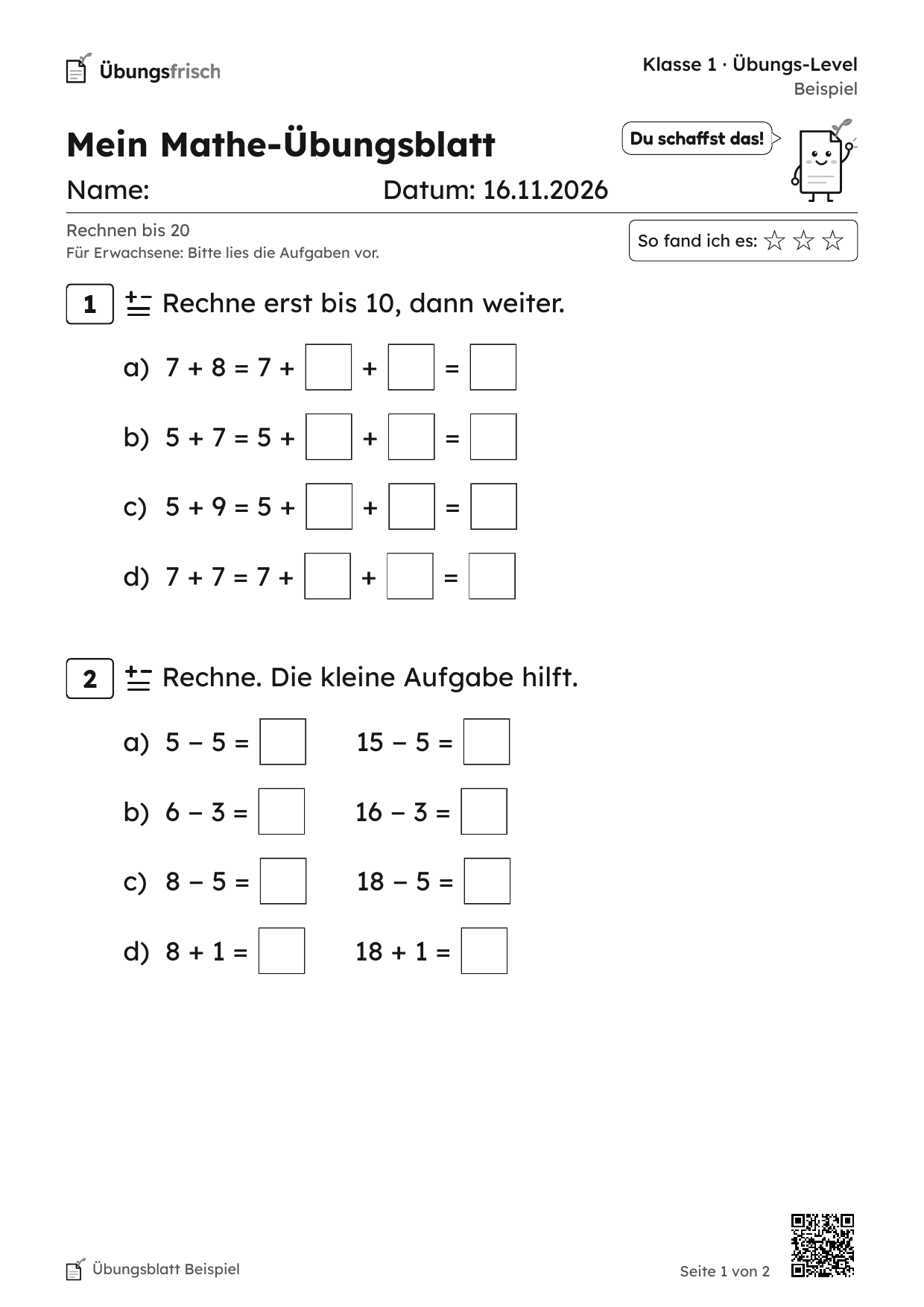
Free sample worksheet
A real worksheet with 5 exercises, just as Übungsfrisch creates it, plus the matching answer key with worked solutions. Like the maths lessons at your child’s school, the sheet is in German. Print it on A4 – no sign-up needed.
What it’s about
During grade 1 the number range grows to 20, and with it comes the biggest hurdle of the school year: bridging ten (Zehnerübergang). In 8 + 5 the result goes past 10. Most classes start by calculating in steps: first to 10, then on („erst bis 10, dann weiter“). Your child splits the 5 so that the 8 becomes 10, so 8 + 2 + 3 = 13. For this they need the pairs that make 10 from the number house (Zahlenhaus).
A second route uses doubles (Verdopplungsaufgaben). Many children soon know 6 + 6 = 12 by heart, and from it follows the near double (Nachbaraufgabe) 6 + 7 = 13 – simply one more. Then there are analogy tasks (Analogieaufgaben): anyone who knows 3 + 5 = 8 can also work out 13 + 5 = 18, because only the ten is added. On the sample sheet your child practises all three routes: first to 10 and then on, doubles and near doubles, and small sums that help with bigger ones. You read the tasks aloud; the sheet prints a note for adults and a small picture symbol in front of each exercise.
By the end your child should solve sums to 20 that bridge ten without counting one by one, and explain how they worked them out. This carries them through grade 2, when the numbers to 100 arrive.
Typical mistakes
- The rest is forgotten or added wrongly: for 8 + 5 = 8 + 2 + 3 your child stops after 8 + 2 = 10, or then works out 10 + 5 = 15 instead of 10 + 3 = 13.
- The near double goes the wrong way: from 7 + 7 = 14 follows 7 + 6 = 13, not 15.
- In analogy tasks the ten gets lost: 15 − 3 is 12, not 2 – with the ten, 5 − 3 = 2 becomes 12.
Example tasks
First to 10, then on: 7 + 6
Show answer
13 (7 + 3 = 10, then 10 + 3 = 13)
Double, then work out the near double: 8 + 8 and 8 + 9
Show answer
16 and 17 (8 + 9 is one more than 8 + 8)
The small sum helps: 4 + 3 and 14 + 3
Show answer
7 and 17
Practising at home
Two egg boxes that hold ten eggs each and a few marbles make bridging ten visible: fill one box first, then carry on in the second. If an answer differs from the answer key, look together at the in-between steps written there.
A new sheet on exactly this topic every time – no repeats
With Übungsfrisch you pick the topic your child is doing at school right now and get a new worksheet every time, with an answer key and worked solutions. Join the waitlist – we’re inviting families step by step.
Join the waitlistRelated topics
- Adding and subtracting to 10 – grade 1 worksheet with answersGrade 1 maths in Germany: addition and subtraction to 10 with picture tasks, inverse tasks and missing numbers. Free printable worksheet with answers.
- Number bonds with the number house – grade 1 worksheetNumber bonds to 10 for grade 1 in Germany: number houses (Zahlenhaus), counter pictures and making 10. Free printable worksheet with answer key.
- Numbers to 20 – grade 1 worksheet with the twenty frameGrade 1 maths in Germany: count to 20 with dice pictures, the twenty frame (Zwanzigerfeld) and tally marks. Free printable worksheet with answer key.