


Adding and subtracting to 100 – empty number line and methods for grade 2
Further down you’ll find a free worksheet on calculating to 100, with an answer key showing all the in-between steps. Übungsfrisch keeps creating new exercises, so your child never works out the same one twice.
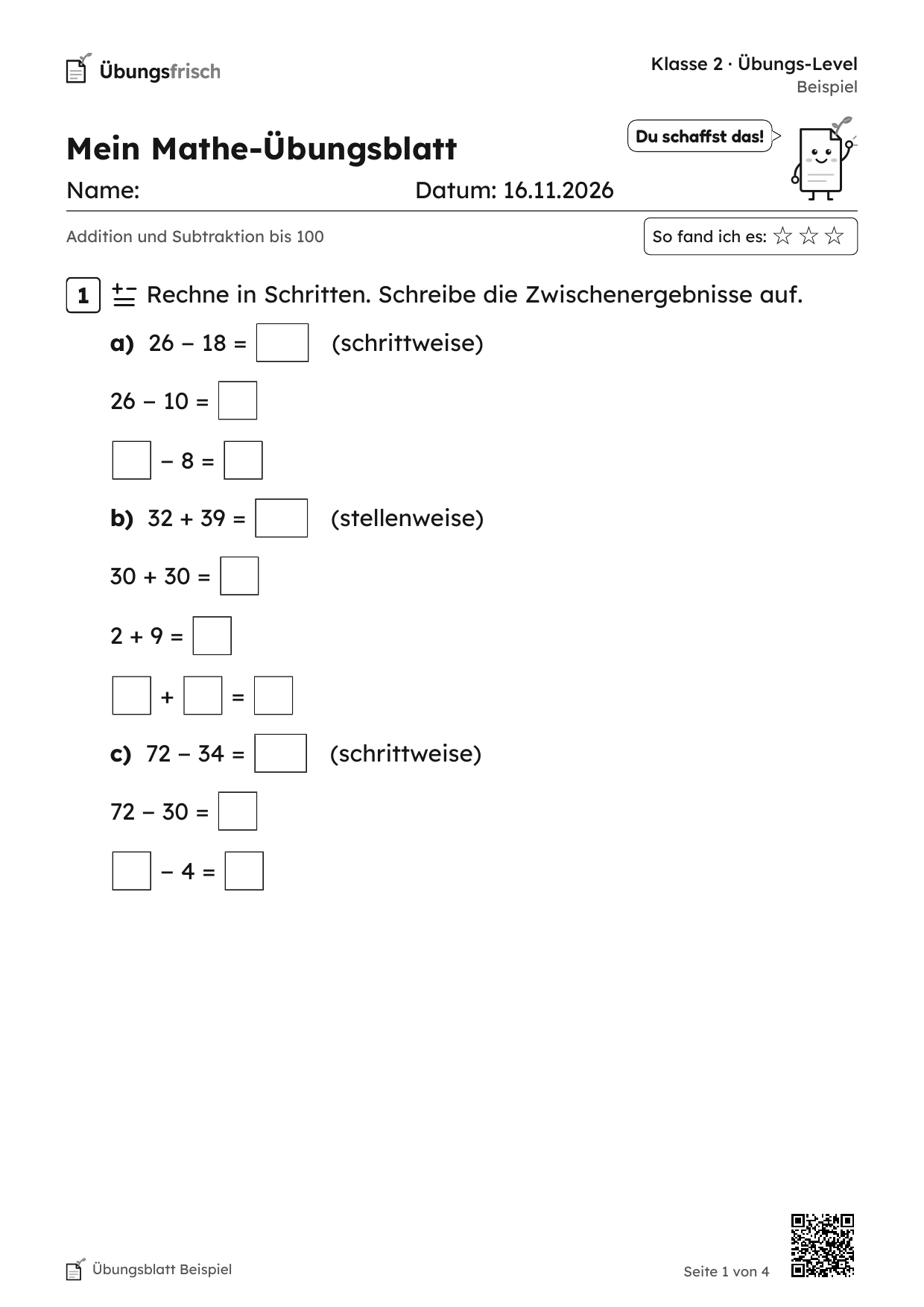
Free sample worksheet
A real worksheet with 7 exercises, just as Übungsfrisch creates it, plus the matching answer key with worked solutions. Like the maths lessons at your child’s school, the sheet is in German. Print it on A4 – no sign-up needed.
What it’s about
With numbers up to 100, counting is no longer enough. In grade 2 your child therefore learns to break sums such as 32 + 39 or 72 − 34 into smaller steps. Schools call this halbschriftliches Rechnen (“half-written” calculation): the in-between results are written down, the calculating happens in the head. Bridging tens (Zehnerübergang) matters most here – sums that cross a multiple of ten.
Two methods come up often. In step-by-step calculation (schrittweise) the first number stays and the second is split: 72 − 34 = 72 − 30 − 4, so 42 − 4 = 38. In place-value calculation (stellenweise) tens and ones are worked out separately: 32 + 39 gives 60 + 11 = 71. The empty number line (Rechenstrich), a line without a scale, makes the jumps visible. To find a missing number by counting on (Ergänzen), your child jumps from the smaller to the bigger number, ideally via a multiple of ten.
On the sample sheet your child calculates in steps with in-between results, marks jumps and numbers on the empty number line, fills in missing numbers up to the next multiple of ten or to 100, and solves mental maths tasks. By the end they should solve additions and subtractions to 100 confidently and explain which method they chose.
Typical mistakes
- In subtraction the smaller ones digit is simply taken from the bigger one: 72 − 34 then gives 42 instead of 38.
- In place-value calculation a ten gets lost: 32 + 39 is 60 + 11 = 71, not 61.
- Counting on to 100 gives one ten too many: 68 + __ = 100 is 32, not 42.
Example tasks
Calculate step by step: 83 − 47
Show answer
36 (83 − 40 = 43, 43 − 7 = 36)
Calculate by place value: 46 + 38
Show answer
84 (40 + 30 = 70, 6 + 8 = 14, 70 + 14 = 84)
Count on along the empty number line: 37 + __ = 82
Show answer
45 (37 + 3 = 40, 40 + 40 = 80, 80 + 2 = 82; together 3 + 40 + 2 = 45)
Practising at home
When reading aloud together, slip in small counting-on questions: “The book has 100 pages and we’re on page 63 – how many are left?” Because the answer key also shows the in-between steps, you’ll quickly find where a mistake crept in.
A new sheet on exactly this topic every time – no repeats
With Übungsfrisch you pick the topic your child is doing at school right now and get a new worksheet every time, with an answer key and worked solutions. Join the waitlist – we’re inviting families step by step.
Join the waitlistRelated topics
- Numbers to 100 – grade 2 worksheet with hundred field and hundred squareNumbers to 100 for grade 2 in Germany: tens and ones, number words, the hundred dot field and the hundred square. Free printable worksheet with answers.
- Times tables (Einmaleins) – grade 2 worksheet to understand and practise multiplicationTimes tables for grade 2 in Germany: multiplication with dot arrays and pictures, times-table rows and core facts (Kernaufgaben). Free worksheet, answers.
- Telling the time – grade 2 worksheet with clocks to read and drawTelling the time in grade 2 in Germany: read half and quarter hours, draw the clock hands, work out durations. Free printable worksheet with answers.