


Numbers to 100 – grade 2 worksheet with hundred field and hundred square
Below there’s a free sample sheet on numbers to 100, with an answer key for checking. Übungsfrisch puts together a new sheet on this topic every time, and your child never gets the same exercise twice.
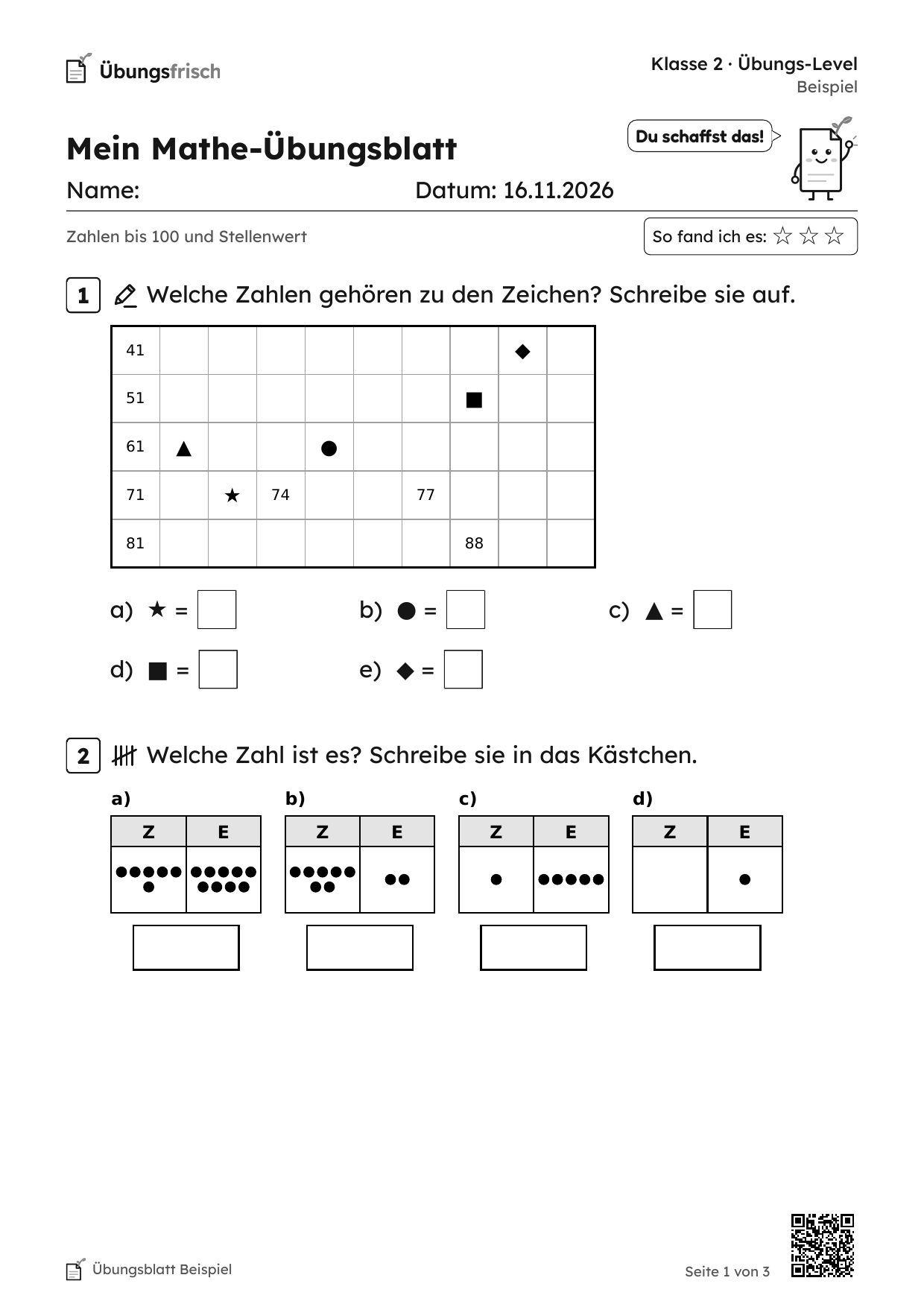
Free sample worksheet
A real worksheet with 7 exercises, just as Übungsfrisch creates it, plus the matching answer key with worked solutions. Like the maths lessons at your child’s school, the sheet is in German. Print it on A4 – no sign-up needed.
What it’s about
In grade 2 the number range grows from 20 to 100 (Zahlenraum bis 100). To really understand the new numbers, children do a lot of bundling (Bündeln): ten ones are grouped into one ten. The place value chart (Stellentafel) has two columns for this, tens (Z, Zehner) and ones (E, Einer). With 6 counters under Z and 9 under E, the number is 69. Number words need practice too, because German says the ones first: „neunundsechzig“ is literally “nine-and-sixty”. English number words say the tens first, so children who also speak English often swap digits here.
Two pictures accompany your child through the whole school year. The hundred field (Hunderterfeld) shows 100 dots in ten rows, with a gap after five rows and after five columns. That way 47 dots are quickly seen as 4 full rows and 7 single dots, without counting each one. The hundred square (Hundertertafel) lists the numbers 1 to 100 in rows of ten: one square to the right is 1 more, one square down is 10 more.
On the sample sheet your child reads counters in the place value chart and draws some in, matches number words to the right numbers, counts black dots in the hundred field and colours in a given amount. They also find numbers hidden behind symbols such as ★ or ● in a section of the hundred square. By the end they should be able to build, read, write and find any number up to 100 on the square.
Typical mistakes
- Digits swapped when writing: „vierundsechzig“ (literally “four-and-sixty”) is 64, not 46 – you hear the 4 first, but it belongs in the ones place.
- Without bundling the number gets too long: 3 tens and 12 ones are 42, not 312.
- The end of a row slips: 60 is at the far right of the row that starts with 51, not at the beginning of the next row.
Example tasks
Which number is it? 5 tens and 14 ones
Show answer
64 (14 ones are 1 ten and 4 ones, so 6 Z + 4 E)
Write in digits: „achtundsiebzig“
Show answer
78 (literally “eight-and-seventy”)
On the hundred square, start at 46. Go 1 square down and 2 squares to the right. Which number is there?
Show answer
58 (46 + 10 = 56, 56 + 2 = 58)
Practising at home
When tidying up, count in packs of ten: how many tens and how many ones are 34 building blocks? The answer key also shows the counters drawn in and the dots coloured, so you can see together where a ten might be missing.
A new sheet on exactly this topic every time – no repeats
With Übungsfrisch you pick the topic your child is doing at school right now and get a new worksheet every time, with an answer key and worked solutions. Join the waitlist – we’re inviting families step by step.
Join the waitlistRelated topics
- Adding and subtracting to 100 – empty number line and methods for grade 2Addition and subtraction to 100 for grade 2 in Germany: empty number line, step-by-step and place-value methods, mental maths. Free worksheet, answers.
- Times tables (Einmaleins) – grade 2 worksheet to understand and practise multiplicationTimes tables for grade 2 in Germany: multiplication with dot arrays and pictures, times-table rows and core facts (Kernaufgaben). Free worksheet, answers.
- Telling the time – grade 2 worksheet with clocks to read and drawTelling the time in grade 2 in Germany: read half and quarter hours, draw the clock hands, work out durations. Free printable worksheet with answers.