


Telling the time – grade 2 worksheet with clocks to read and draw
A free telling-the-time worksheet with answer key is ready to print further down. With Übungsfrisch you get new clocks and durations on this topic every time, and no exercise repeats.
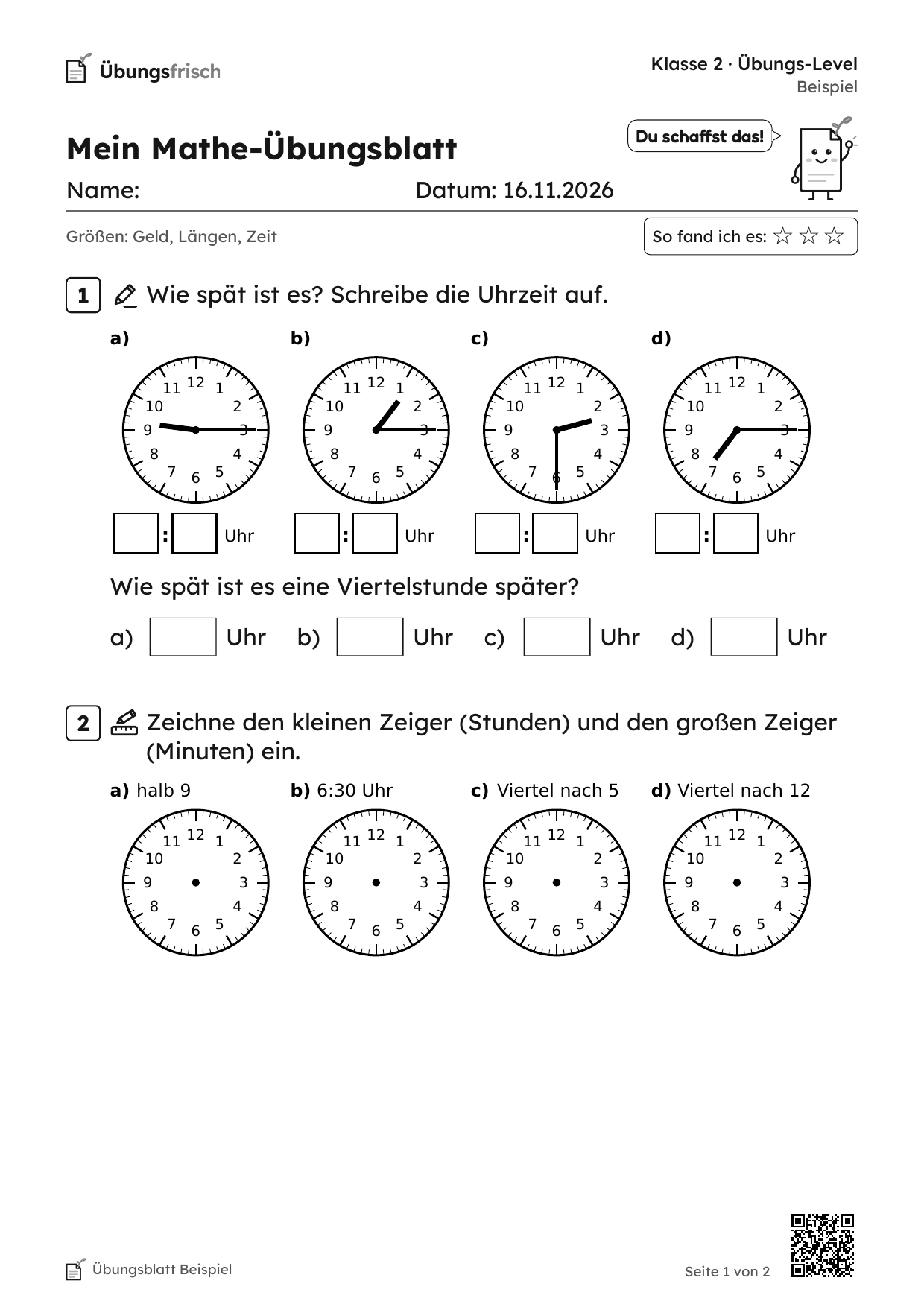
Free sample worksheet
A real worksheet with 5 exercises, just as Übungsfrisch creates it, plus the matching answer key with worked solutions. Like the maths lessons at your child’s school, the sheet is in German. Print it on A4 – no sign-up needed.
What it’s about
Reading a clock is a real hurdle for many children in grade 2. On the clock face the two hands show two different things: the short hand shows the hours, the long hand the minutes. On top of that come two ways of saying the time. A digital clock shows 8:30, but people often say „halb neun“ (“half nine”) – and that means half an hour before 9. This catches out many English-speaking parents: in British English “half nine” is 9:30, in German it’s 8:30. In the same way, „Viertel vor 4“ (quarter to 4) is 3:45 Uhr.
How far grade 2 goes depends on the federal state (Bundesland) and the school. Usually it’s full, half and quarter hours; some classes already read in five-minute steps or to the exact minute. Also, every time occurs twice a day. German schools write times with „Uhr“ (o’clock) and use the 24-hour clock, so quarter past 7 can be 7:15 Uhr or 19:15 Uhr.
On the sample sheet your child reads clocks showing a half or quarter hour and works out what time it is a quarter or half an hour later. On blank clock faces they draw both hands themselves. In a table with start, duration and end, they fill in missing times and durations from 15 minutes to 2 hours. By the end they should read the clock confidently and work out short durations in everyday life.
Typical mistakes
- The hands are swapped: if the long hand points to 3 and the short hand is just past 9, it’s 9:15 Uhr, not 3:45 Uhr.
- „Halb 9“ is read as 9:30 Uhr – correct is 8:30 Uhr, because it’s the half hour before 9.
- When adding on, the minutes overflow: 6:45 Uhr plus half an hour is 7:15 Uhr, not 6:75 Uhr, because an hour has 60 minutes.
Example tasks
The long hand points to 6, the short hand is exactly between 4 and 5. What time is it?
Show answer
4:30 Uhr or 16:30 Uhr („halb fünf“, half past four)
What time is it a quarter of an hour after 10:45 Uhr?
Show answer
11:00 Uhr (10:45 Uhr + 15 min)
A film starts at 17:15 Uhr and ends at 17:45 Uhr. How long is it?
Show answer
30 min, so half an hour
Practising at home
Hang a clock with hands where your child often sees it, and before heading out ask briefly: “What time is it, and how long is it until …?” For the drawn clocks the answer key helps: there your child sees that the short hand often sits between two numbers.
A new sheet on exactly this topic every time – no repeats
With Übungsfrisch you pick the topic your child is doing at school right now and get a new worksheet every time, with an answer key and worked solutions. Join the waitlist – we’re inviting families step by step.
Join the waitlistRelated topics
- Times tables (Einmaleins) – grade 2 worksheet to understand and practise multiplicationTimes tables for grade 2 in Germany: multiplication with dot arrays and pictures, times-table rows and core facts (Kernaufgaben). Free worksheet, answers.
- Adding and subtracting to 100 – empty number line and methods for grade 2Addition and subtraction to 100 for grade 2 in Germany: empty number line, step-by-step and place-value methods, mental maths. Free worksheet, answers.
- Numbers to 100 – grade 2 worksheet with hundred field and hundred squareNumbers to 100 for grade 2 in Germany: tens and ones, number words, the hundred dot field and the hundred square. Free printable worksheet with answers.